
Break of Structure vs Change of Character: BOS and CHoCH Explained
PipSePaisa • Forex Education & Research
INTRODUCTION
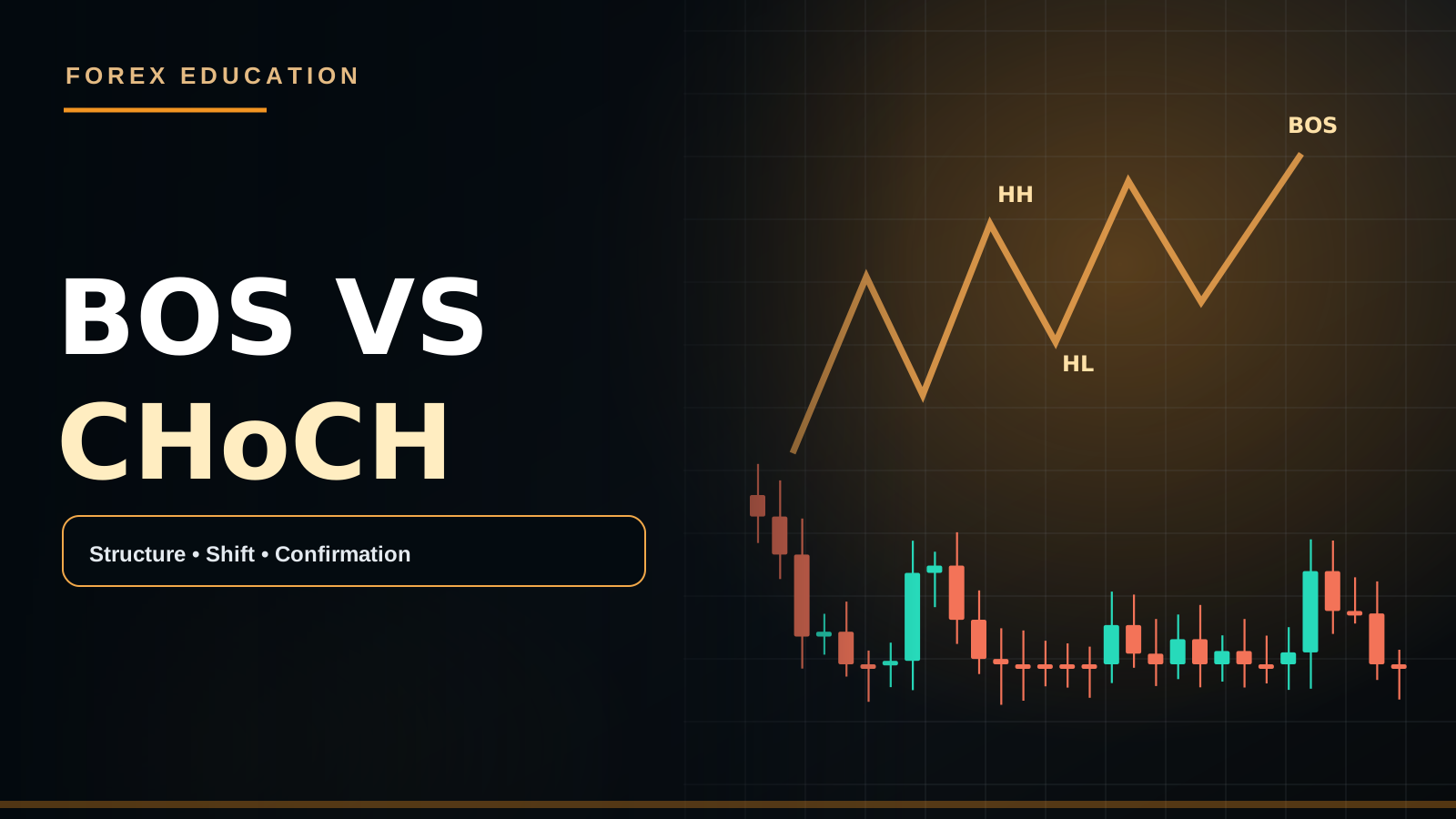
Break of Structure (BOS) and Change of Character (CHoCH) are terms frequently used in Smart Money Concepts. BOS often describes a break that continues the prevailing swing sequence; CHoCH often describes an opposing break that may mark an early shift. Definitions differ among educators, so transparent swing rules are more useful than labels alone.
1. IDENTIFY THE REFERENCE SWING
On H1 or H4, mark significant confirmed swing highs and lows. In a bullish sequence, higher highs and higher lows define context. If price breaks above the preceding meaningful high, this may be labeled bullish BOS in a continuation framework.
2. WHAT CHoCH SUGGESTS
In an uptrend, a decisive break below the relevant higher low may indicate a potential change in short-term control. Some models require a candle close beyond the swing, while others use wicks or an additional confirmation break. A possible shift is not proof that the larger trend has reversed.
3. INTERNAL VS EXTERNAL STRUCTURE
Small M1 or M5 swings can turn bearish while H1/H4 remains bullish. Label internal breaks separately from higher-timeframe structure. Failing to distinguish them makes nearly every minor pullback look like a reversal.
4. EDUCATIONAL EXAMPLE
Imagine H1 highs at 100 then 108 and lows at 96 then 103. A climb above 108 may count as continuation BOS. If price later breaks decisively below the important 103 higher low, the H1 bullish structure is challenged; an M5 break below a tiny intra-swing would carry much less weight.
5. ENTRY FRAMEWORK
After a credible CHoCH, some traders wait for a retracement to a relevant supply/demand zone or order block. They then require a closed confirmation candle and place invalidation beyond the relevant swing. This is one possible model, not a guaranteed institutional-order signal.
6. FILTER FALSE SIGNALS
Check whether the break is merely a liquidity sweep, whether it occurs inside a larger consolidation, whether a scheduled data release caused a momentary spike, and whether price retests the broken structure.
7. BOS/CHoCH LIMITATIONS
Two analysts may choose different swing points and produce different labels. Backtesting must define swing-selection rules, candle-close requirements, timing and stop placement to be meaningful.
FAQ
Is CHoCH always a reversal? No. Can bullish BOS happen in a bearish H4 market? Yes, on a smaller timeframe during a countertrend rally.
START WITH CONFIRMED SWING POINTS
SMC labels depend on how swings are defined. Mark meaningful local highs and lows on H1 or H4; use a consistent rule for when a swing is confirmed. A small wick through a random candle high is not equivalent to a completed break of an important reference swing.
BOS AS A CONTINUATION DESCRIPTION
In one common framework, an uptrend has higher highs and higher lows. Price closing above the preceding meaningful higher high may be called bullish Break of Structure. In a downtrend, a lower low break can be called bearish BOS. The terminology describes price behavior and does not prove who placed the orders.
CHoCH AS A POTENTIAL SHIFT
If bullish structure has been intact but price decisively breaks a meaningful higher low, some traders call it bearish Change of Character. This suggests the prior swing sequence is under pressure. A full higher-timeframe reversal might require additional confirmation. Different mentors use related labels such as Market Structure Shift differently, so define your approach explicitly.
INTERNAL VS EXTERNAL STRUCTURE
M5 may make a bearish CHoCH inside a bullish H1 trend as part of a normal pullback. An H1 break of a major higher low carries a different context. Do not change the timeframe or swing definition after entering just to justify a losing position.
STEP-BY-STEP EXAMPLE
An H1 instrument forms lows 96 and 103 while highs rise from 100 to 108. Price breaks above 108: possible bullish BOS. Later it closes below 103: the H1 bullish sequence is challenged and a bearish CHoCH interpretation may arise. An M5 lower low somewhere inside the pullback would not carry equivalent importance.
TRADING AFTER A STRUCTURE CHANGE
Some models wait for the price to return to a newly formed order block or Supply/Demand Zone. Then they seek M5/M15 rejection and an entry with a stop beyond the new swing extreme. A CHoCH alone is not a Buy/Sell trigger. Nearby high-impact news or conflicting H4 direction may make the trade unattractive.
FAQ
Does one CHoCH guarantee reversal? No. Is BOS defined by wick or close? Frameworks differ; close confirmation can reduce certain false breaks. Can BOS be bullish on M5 while H1 is bearish? Yes.
WHY THE TERMS ARE OFTEN MISUNDERSTOOD
BOS and CHoCH are labels from widely used Smart Money Concepts discussions, but they do not have one universal official exchange definition. Different educators choose different swing-selection rules, candle-close requirements and labels for related concepts such as Market Structure Shift (MSS). The useful educational skill is describing exactly which price level broke, on which timeframe, and whether the close was confirmed.
CONFIRM THE EXISTING TREND FIRST
To identify a continuation break, establish the prior swing direction. For a bullish H1 structure, locate significant higher highs and higher lows. For bearish structure, identify lower highs and lower lows. If price is ranging, calling every new five-minute high a bullish BOS may be misleading. A break only matters relative to a defensible reference swing.
BULLISH BREAK OF STRUCTURE
In a common continuation model, a completed candle close above a significant prior swing high in an established uptrend qualifies as bullish BOS. Example: H1 higher lows form at 1.0950 and 1.0990, while a prior swing high is 1.1050. A strong close above 1.1050 may extend bullish structure. But if H4 Supply lies just above, continuation room can still be limited. BOS identifies a structural event; it does not determine stop or target automatically.
BEARISH BREAK OF STRUCTURE
In a downtrend making lower lows and lower highs, a confirmed move below the preceding meaningful swing low may be bearish BOS. A temporary lower wick below the low that closes back inside the prior range may instead resemble a liquidity sweep under close-based criteria. The market can resume downward after a sweep or reverse, so subsequent candles matter.
CHANGE OF CHARACTER
CHoCH usually points to a break opposing the previously established swing structure. Suppose H1 has been bullish and its latest significant higher low is 1.0990. If a candle closes decisively below 1.0990, the bullish sequence is challenged. Some traders label this bearish CHoCH. The event can be an early warning of reversal, but price may merely enter consolidation or later regain the level. Require additional confirmation if your model calls for it.
CHoCH VERSUS MSS
Some trading schools use Change of Character and Market Structure Shift interchangeably, while others distinguish them through displacement strength or swing hierarchy. Instead of claiming one label is universally correct, document what the strategy means by each: reference swing, closing condition, displacement and retest requirement. Without definitions, results cannot be reproduced across traders.
INTERNAL AND EXTERNAL STRUCTURE
A bearish M5 CHoCH occurring inside a bullish H4 trend may simply describe the beginning of a short-term pullback. An H4 break of a significant higher low would imply a more material change. When one chart says bullish BOS and another says bearish CHoCH, both may be true at different scales. Choose a timeframe hierarchy before trading rather than selecting whichever label supports the desired position.
DISPLACEMENT AND FOLLOW-THROUGH
A large decisive candle crossing a swing level may provide stronger evidence of changed urgency than a one-point wick, but an oversized candle also creates poor entry economics if chased. Observe whether price holds beyond the broken swing, forms new highs/lows or retests the boundary. Strong displacement during NFP or CPI may be temporary; economic context and spread matter.
BOS, CHoCH AND ORDER BLOCKS
A common SMC framework links a structural break to a preceding origin candle or Order Block. After a bearish CHoCH, the trader might identify a supply-like origin zone and wait for retest. This organizes a possible setup but does not prove that institutional orders remain at that candle. If price returns, lower-timeframe confirmation, structural invalidation and position sizing are still necessary.
LIQUIDITY SWEEP BEFORE CHoCH
Sometimes price trades above Equal Highs, then returns below the range and breaks a local higher low. Some traders interpret the upper move as Buy-Side Liquidity Sweep followed by bearish CHoCH. But not every equal-high break is manipulation, and not every CHoCH results in sustained selling. Avoid retroactively classifying every winner as a perfect sweep model.
A NUMERICAL SCENARIO
Suppose price forms H1 swing low 96, swing high 100, higher low 103 and higher high 108 within an illustrative upward progression. A close above 108 may represent bullish BOS. If price later closes below the important 103 low, some frameworks identify bearish CHoCH. However, a separate H4 trend may still be bullish. The example demonstrates why one timeframe's change is not the whole market.
FROM STRUCTURAL LABEL TO EXECUTION
A practical model might require: higher-timeframe area reached; liquidity reference tested; meaningful CHoCH completed; pullback to a selected origin zone; M5/M15 confirmation; Stop Loss beyond the relevant swing; target toward an opposing level. If the chain is incomplete, staying flat preserves discipline. A standalone label without risk logic is not a strategy.
BACKTESTING QUESTIONS
Which candles confirm a swing? Is a Wick break accepted or is body close required? Which timeframe sets trend direction? Does the trigger expire after several bars? Is retest compulsory? How are FVG/Order Blocks selected? Are CPI/NFP windows excluded? Write the answers before reviewing outcomes.
FAQ
Does a bullish BOS mean guaranteed Buy? No. Can CHoCH happen inside a larger uptrend? Yes. Must every CHoCH reverse market direction? No. Is MSS always the same as CHoCH? Terminology varies. Why wait for completed close? To avoid calling an unfinished candle a confirmed structure break.
CONCLUSION
Use BOS and CHoCH to describe changes in confirmed price structure, not as standalone buy/sell instructions.
PIPSEPAISA FREE COURSES
Sir Sajid Khan Ghori — Free Forex Technical Analysis Course. Want to join? Message the team on WhatsApp or visit the Courses tab at www.pipsepaisa.com to enroll.
Sir Ghulam Abbas — Free Forex Fundamental Analysis Course. Message on WhatsApp or visit the Courses tab for enrollment.
RISK DISCLAIMER
Educational hypothetical examples only. Trading may result in loss, especially when leveraged.
Read in Roman Urdu
INTRODUCTION
SMC mein BOS (Break of Structure) aur CHoCH (Change of Character) important labels hain. BOS aksar current trend ki continuation break ke liye aur CHoCH possible shift ke liye use hota hai. Mentors ki definitions different ho sakti hain.
1. SWING SELECT KAREIN
H1/H4 par meaningful swing high aur low mark karein. Bullish HH/HL sequence mein previous significant high ke upar break continuation BOS indicate kar sakti hai.
2. CHoCH
Uptrend ka relevant Higher Low decisively break ho to bullish control weak ho sakta hai. Lekin ye immediately full reversal ki guarantee nahi.
3. INTERNAL/EXTERNAL STRUCTURE
M5 par bearish shift ho sakta hai jabke H1 bullish ho. Small internal break aur important H1 break ko same importance na dein.
4. EXAMPLE
H1 highs 100 aur 108, lows 96 aur 103 hon. 108 ke upar clear break bullish BOS ho sakta hai. Baad mein 103 ke neeche strong break bullish H1 structure challenge karta hai.
5. ENTRY PROCESS
CHoCH ke baad relevant Supply/Demand ya Order Block ka retest wait kar sakte hain. Confirmation candle close aur structure-based SL plan karein.
6. FAKE BREAK FILTER
Check karein kya sirf wick sweep hai, larger range chal rahi hai, ya high-impact news ne momentary spike diya hai.
7. LIMITATIONS
Different swing selection ki wajah se do traders alag BOS/CHoCH mark kar sakte hain. Is liye backtest mein rules objective hone chahiye.
FAQ
Kya CHoCH guaranteed reversal? Nahi. Kya M5 BOS H4 trend ke opposite ho sakta hai? Haan.
PEHLE SWING HIGH/LOW DEFINE KAREIN
BOS aur CHoCH samajhne se pehle H1/H4 par meaningful Swing High aur Swing Low mark karein. Aapka rule consistent hona chahiye ke swing kab confirmed hai. Random candle high ke upar Wick aur important H1 structure ka Candle Close same nahi.
BOS CONTINUATION KYA HAI?
Common SMC framework mein Uptrend HH/HL banata hai. Agar price significant previous Higher High ke upar strong close kare to bullish BOS label ho sakta hai. Downtrend mein important Lower Low ke neeche break bearish BOS kehlati hai. Ye price behavior ka description hai, actual institutional order proof nahi.
CHoCH KAB BANTA HAI?
Bullish structure mein important Higher Low decisively break ho to bearish CHoCH potential shift indicate kar sakta hai. Is se full H4 reversal guaranteed nahi. Different mentors CHoCH aur Market Structure Shift ko thora alag define karte hain. Apna exact criteria written rakhein.
INTERNAL AUR EXTERNAL
M5 bearish CHoCH H1 uptrend ke andar normal pullback bhi ho sakta hai. H1 major Higher Low break ka meaning different hoga. Ek trade ko justify karne ke liye timeframe switch karna avoid karein.
NUMERICAL EXAMPLE
H1 lows 96 aur 103, highs 100 aur 108 hain. Price 108 ke upar break kare to possible Bullish BOS hai. Baad mein 103 ke neeche confirmed close aaye to H1 bullish sequence weak hoti hai aur bearish CHoCH ka clue milta hai. Pullback mein chhota M5 low break equally important nahi.
CHoCH KE BAAD ENTRY
Kuch SMC strategies Order Block ya Supply/Demand Zone ke retest ka wait karti hain. M5/M15 par rejection close mile to Stop Loss new swing ke beyond plan ki ja sakti hai. Sirf CHoCH label dekh kar blind trade na lein. H4 direction aur news check karein.
FAQ
Ek CHoCH guaranteed reversal? Nahi. Wick ya Close? Apke model par depend, consistent rehna zaroori. M5 Bullish BOS aur H1 Bearish same waqt? Haan.
BOS AUR CHoCH KE NAMES MEIN CONFUSION KYUN?
BOS aur CHoCH Smart Money Concepts mein widely use hone wale labels hain, lekin kisi ek Exchange ki universal official definition nahi. Different mentors Swing Select karne ka rule, Wick vs Candle Close aur Market Structure Shift (MSS) terminology differently use karte hain. Important ye hai ke aap clear likhein: kaunsa Swing break hua, kis timeframe par aur kya Completed Candle Close mil gayi? Sirf label ko trading edge mat samjhein.
PEHLE EXISTING TREND DEFINE KAREIN
Continuation BOS identify karne se pehle Current Swing Direction samjhein. H1 bullish hai to meaningful Higher High aur Higher Low mark karein. H1 bearish hai to Lower High aur Lower Low. Agar market Range mein hai to har M5 new candle high ko strong bullish BOS kehna misleading ho sakta hai. Break tab important hota hai jab actual relevant reference Swing identified ho.
BULLISH BOS KA EXAMPLE
Common trend-continuation model mein Bullish H1 sequence ke andar previous important Swing High ke upar decisive Candle Close ko Bullish BOS kaha ja sakta hai. Example H1 Lows 1.0950 aur 1.0990, previous High 1.1050 hai. Price 1.1050 se upar strong close de to Bullish Structure extend ho sakti hai. Lekin agar H4 Supply bilkul upar ho to continuation Target limited ho sakta hai. BOS se automatic SL/TP calculate nahi hota.
BEARISH BOS KA EXAMPLE
Downtrend mein previous meaningful Swing Low ke neeche confirmed break Bearish BOS ho sakta hai. Agar sirf Wick low ke neeche ja kar Candle Range ke andar wapas close ho to Close-based criteria mein full BOS nahi. Ye temporary Liquidity Sweep ho sakti hai. Phir price trend continue bhi kar sakti hai ya reverse bhi. Next completed candles aur H1/H4 Market Context ko assess karein.
CHoCH KYA SIGNAL KARTA HAI?
CHoCH previous Swing Sequence ke opposite meaningful break ka possible label hai. Maan lein H1 bullish structure ka important Higher Low 1.0990 hai. Price 1.0990 ke neeche strong close de to Bullish Progress challenge ho sakti hai. Kuch traders isay Bearish CHoCH kehte hain. Ye early warning hai, guaranteed complete bearish reversal nahi. Price sideway ya old level reclaim bhi kar sakti hai.
CHoCH AUR MSS MEIN FARQ
Kuch SMC Trading Schools CHoCH aur Market Structure Shift ko same concept ki tarah use karti hain. Kuch mentors MSS ke liye strong displacement ya specific Swing Hierarchy demand karte hain. Is liye kisi ek terminology ko universal fact kehna zaroori nahi. Apni written strategy mein define karein Swing Reference, Candle Close, Displacement aur Retest ki conditions kya hain. Tab backtesting reproducible hogi.
INTERNAL VS EXTERNAL SWINGS
M5 Bearish CHoCH H4 Bullish Uptrend ke andar normal pullback ka start ho sakti hai. H4 ka major Higher Low break ho to structural significance comparatively larger ho sakti hai. Agar M5 bullish BOS aur H1 bearish CHoCH ek waqt par nazar aayen to dono apne respective timeframes par technically correct ho sakte hain. Trading se pehle hierarchy set karein: H4 Bias, H1 Level, M5 Entry.
DISPLACEMENT AUR FOLLOW-THROUGH
Strong Candle Swing Break kar ke close kare to changed market urgency ka clue mil sakta hai. Lekin bohat large displacement candle ko chase karne se SL wide aur RR poor ho sakta hai. Dekhein price broken level ke beyond hold karti hai, retest par reaction deti hai ya range mein return. CPI/NFP News par temporary Spikes aur wide spreads interpretation ko complicate kar sakti hain.
ORDER BLOCK KE SAATH BOS/CHoCH
SMC mein Structural Break ke origin ke qareeb Last Opposite Candle ya Order Block mark ki ja sakti hai. Bearish CHoCH ke baad Trader Supply-like OB retest wait karta hai. Ye ek structured setup model hai, guarantee nahi ke exact institutional orders wahi pending hain. Retest par M5 confirmation aur Stop Loss Invalidation phir bhi required honge.
LIQUIDITY SWEEP KE BAAD CHoCH
Price Equal Highs ke upar wick de kar range mein return kare aur phir M5 Higher Low break ho, to kuch traders Buy-Side Liquidity Sweep + Bearish CHoCH ka model consider karte hain. Lekin har Equal High break manipulation nahi aur har CHoCH strong downtrend nahi deta. Sirf successful historical trades ko select kar ke is model ko perfect present mat karein.
NUMERICAL STRUCTURE EXAMPLE
Hypothetical price H1 Low 96, High 100, Higher Low 103 aur Higher High 108 banati hai. Price 108 ke upar close kare to continuation Bullish BOS ho sakti hai. Baad mein 103 ke neeche important Close aaye to kuch models Bearish CHoCH identify karenge. Lekin H4 par broader bullish trend abhi intact bhi ho sakti hai. Is se different Timeframes ka importance samajh aata hai.
STRUCTURE SE ENTRY TAK STEPS
Step 1 H1/H4 zone tak price aaye. Step 2 meaningful Liquidity Area test. Step 3 CHoCH Completed Candle Close. Step 4 relevant OB/Supply/Demand ka Retest. Step 5 M5/M15 Confirmation. Step 6 Structural Stop Loss. Step 7 Dollar Risk se Lot Size. Step 8 realistic opposing zone tak TP. Agar chain incomplete hai to No Trade. Sirf 'CHoCH mil gaya' complete strategy nahi.
BACKTEST QUESTIONS
Swing kitni candles ke baad confirm? Wick accepted ya Body Close? H4 ya H1 Direction primary? Trigger kitni candles tak valid? Retest compulsory? FVG/OB ka exact rule? CPI/NFP filter? Historical Chart par ye sab same tarah use karein.
FAQ
Bullish BOS guaranteed Buy? Nahi. H4 uptrend mein M5 CHoCH? Haan. CHoCH guaranteed reversal? Nahi. MSS aur CHoCH always same? Definition vary. Candle Close ka wait kyun? Open Candle ka signal temporary ho sakta hai.
CONCLUSION
BOS aur CHoCH ko structure samajhne ke tools rakhein, blind signals nahi.
PIPSEPAISA FREE COURSES
Sir Sajid Khan Ghori ka Free Forex Technical Analysis Course join karna hai? WhatsApp par message karein ya www.pipsepaisa.com ke Courses tab se enroll karein.
Sir Ghulam Abbas ke Free Forex Fundamental Analysis Course ke liye WhatsApp ya Courses tab use karein.
DISCLAIMER
Ye educational examples hain. Leveraged trading mein capital loss possible hai.
Educational content only. Trading involves risk. Always use independent analysis and appropriate risk management.