
Scaling In and Scaling Out of Forex Trades: Position Management, Partial TP and Total Risk
PipSePaisa • Forex Education & Research
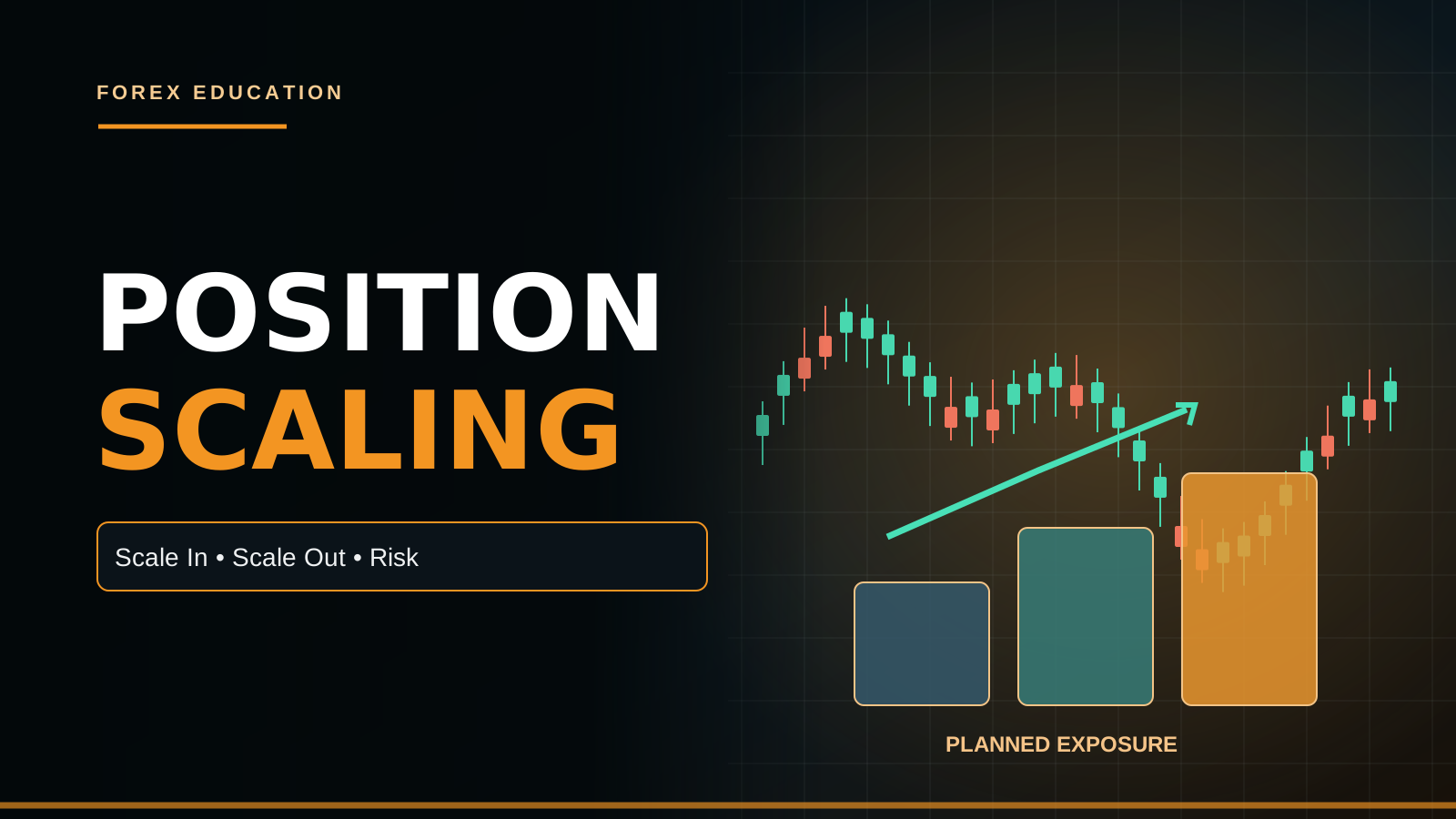
WHAT POSITION SCALING MEANS
Position scaling means adjusting exposure by opening additional units or closing part of an existing trade according to predefined rules. Scaling in increases the total position while scaling out reduces it. A trader might start with partial volume after a confirmed H1 Demand reaction and add only when another valid M5 signal forms, or take partial profits at successive price objectives. Scaling is a position-management technique, not a guarantee of better performance. Every additional order can change risk, average entry price, margin and trading costs.
SCALING IN VERSUS PYRAMIDING
Pyramiding usually describes adding to an already favorable position as price develops in the intended direction, such as adding to a long after a new Higher Low. Scaling in is a broader term and can include multiple planned entries within a zone. Adding as the trade loses money is a different risk profile, often called averaging down. These behaviors should not be treated as interchangeable. A well-documented strategy says precisely when additions are permitted, how much volume they carry and where all stops sit.
WHY TRADERS SCALE IN
Some traders want an initial smaller exposure while a setup develops, adding only if price confirms their hypothesis through completed closes or retests. This can reduce initial monetary exposure if the idea fails immediately, but later entries may have worse prices or reduced target room. The approach can also lead to missed profits when the market moves strongly without offering another entry. A backtest should compare the scaled method with a one-shot entry using the same overall account-risk budget. Neither is automatically superior.
THE TOTAL RISK BUDGET COMES FIRST
Before the first entry, decide the maximum planned monetary loss for the entire trade idea, not merely for each ticket. For example, if account equity is $1,000 and the strategy allows a hypothetical one-percent risk, the entire related position may have a combined planned stop loss of $10. Opening three tickets each risking $10 would expose $30, not $10. Correlated EUR/USD and Gold positions can add portfolio exposure too. Real stop slippage can make actual loss exceed planned amounts.
ALLOCATING RISK ACROSS ENTRIES
One illustrative plan may allocate 0.4% of equity to the first confirmed entry, 0.3% to a second and 0.3% to a third, provided their risks can be measured using actual entry and stop prices. The percentages describe monetary risk, not automatically the percentage of lot size. Two entries with different stop distances need different volumes to represent the same dollar risk. The full position remains subject to a combined maximum budget. An intended later add is optional, not a debt the trader must complete.
A SIMPLE EUR/USD TWO-ENTRY EXAMPLE
Suppose a first EUR/USD Buy occurs at 1.1000 with a structural stop at 1.0980: the distance is twenty pips. A second entry occurs at 1.1010 after a fresh breakout and retest, using the same 1.0980 stop: that leg risks thirty pips. If each leg is intended to risk $5 on a USD account, the required pip values are $0.25 and about $0.1667 respectively before fees. This means unequal lot sizes. The broker's minimum volume increment may prevent exact allocations, requiring the trader to round down or skip.
AVERAGE ENTRY PRICE
If two equal-volume Buy lots are entered at 1.1000 and 1.1020, their simple volume-weighted average entry is 1.1010, ignoring transaction costs. If volumes differ, multiply each entry price by its volume, add the products and divide by total volume. The average entry helps describe the combined exposure but does not determine a safe stop. A weighted average can move toward the later entry even while total loss-at-stop rises. Broker accounting and netting conventions may affect displayed average-price fields.
ADDING TO A LOSING TRADE
Averaging down can reduce a combined long position's average entry price while substantially increasing exposure during an unfavorable move. In a strong bearish trend, every lower entry can lose together. Martingale-like strategies that increase lot sizes after losses may produce attractive short winning streaks but face severe drawdown when trends persist. Some professional strategies use carefully bounded inventory rules, but retail traders should not describe unbounded averaging as ordinary risk management. Any permitted add must have independent evidence, fixed aggregate risk and a credible exit.
ADDING TO WINNERS IS NOT RISK-FREE
A profitable trade can reverse after an additional entry is placed. The original leg might remain positive while the newest leg loses, or both can be stopped out after price retraces. Moving the first Stop to break-even before adding may reduce some planned downside, but stop execution is not guaranteed at the exact price and commissions can turn nominal break-even into a small loss. Calculate the new portfolio loss if every position exits at its defined stop. 'Using house money' does not eliminate risk.
SCALE-OUT AND PARTIAL TAKE PROFIT
Scaling out means closing a portion of the position before the remainder. A trader may take some profit at an H1 opposing level and allow the rest to target a higher-timeframe objective. This can secure realized gains on the closed portion, but the remaining open trade can still lose or give back unrealized profit. Partial exit reduces volume and changes total future exposure. A strategy should determine percentages and levels before entry rather than closing randomly out of fear every time a candle turns red.
A TWO-TARGET R MULTIPLE EXAMPLE
Suppose one initial position has a predefined one-R risk. Half the volume closes at +1R and the remaining half closes at +2R, with no trailing stop complications. The gross combined result is 0.5×1R + 0.5×2R = +1.5R on the initial full-position risk basis. This is less than holding the entire position to +2R, but it also means some profit is realized earlier. Real results depend on execution, stop changes and whether the second objective was reached. Partial exits are a trade-off, not free extra reward.
WHEN THE SECOND TARGET IS NOT HIT
In a partial-exit system, the market may reach TP1 and reverse before TP2. If half the position closes at +1R and the other half eventually hits the original -1R stop, the gross combined outcome is 0.5×1 + 0.5×(-1) = 0R before costs. If the remaining stop had instead been moved to true break-even and filled there, gross profit would be roughly +0.5R, but commissions, spread and slippage still matter. This illustrates why exit rules must be tested together.
BREAKEVEN IS NOT COST-FREE
Moving Stop Loss to entry price is often called a break-even move, but the economic break-even level may differ once spread, commission and swap are included. For long positions, actual entry and exit are often executed at different sides of bid/ask markets, subject to account terms. A stop at the average filled entry can still yield a small realized loss after fees. A market may also touch that stop before moving in the original direction. Define whether your tested break-even rule accounts for costs and whether it improves net expectancy.
TRAILING STOP WITH SCALED POSITIONS
A trailing stop follows price according to a defined method, such as beneath successive H1 Higher Lows for a long trade. Trailing may reduce open downside as the trend develops, but can cause early exits during normal pullbacks. If a new add is made while an existing leg trails, each component's risk should be recalculated at the actual current stop. A single strategy may use different stops for each ticket or a shared stop; the combined outcome needs explicit modeling.
MT5 NETTING AND HEDGING ACCOUNTS
MetaTrader 5 account structures can differ. In a netting system, multiple orders for the same symbol can adjust one net position, with position accounting reflecting aggregated volume. In a hedging system, separate positions on the same symbol may coexist, subject to broker rules. This affects how individual entries, stops and partial exits are managed in the interface or Expert Advisor. Before implementing scaling logic, confirm the account mode, symbol specifications and available order operations. Do not assume every MT5 account displays three Buy entries as three independent tickets.
PENDING ORDERS AND PARTIAL FILLS
A scaling plan may use Buy Limit, Buy Stop or other orders for later entries. A Buy Limit can constrain price but might not fill if price barely touches the level or liquidity is insufficient. A Stop Order can trigger and fill at a worse price during volatile movement. Some venues allow partial fills under their rules. A backtest that assumes every planned add executes perfectly may overstate position size on winners and distort results. Record actual fills rather than only intended order placement.
SPREAD AND COMMISSION WITH MULTIPLE LEGS
Several entries and exits can generate more individual transactions than one initial order and one final close. Total fees may be higher, depending on broker commission schedules and the exact execution. Spread effects are already embedded in many bid/ask fills, so avoid double-counting when measuring net profit. For a small-target intraday strategy, the cost of extra legs may consume a meaningful share of R. Compare actual all-in net performance of scaled versus single-entry models, not only their gross pip charts.
SCALING A GOLD H1 TRADE
Consider a hypothetical Gold H4 uptrend and H1 Demand reaction. The first M5 bullish engulfing qualifies for an initial smaller Buy. A later H1 resistance breakout and confirmed retest might qualify for a second leg, but only if the combined stops fit the planned loss budget. If price immediately accelerates away, the second entry is skipped. Each Gold CFD broker's contract size and tick value must be used to size orders. A visually beautiful ascending chart is not permission to use fixed oversized lots.
SCALING A EUR/USD REVERSAL
Suppose EUR/USD reaches an H4 Supply zone and produces a bearish H1 rejection. A trader opens a small Sell only after completed M5 bearish CHoCH. If price later forms a lower high beneath old Support-turned-Resistance, another Sell might be evaluated if the strategy permits pyramiding. Stop Loss for every leg should follow explicit invalidation rules, and the nearest H1 Demand limits realistic target room. Selling more at every higher price without confirmation would be a different averaging strategy with different risk.
RISK LIMITS WHEN TRADES CORRELATE
Position management must account for exposure across different symbols as well as separate entries on one symbol. A Gold Buy and EUR/USD Buy may both be vulnerable to stronger USD during some regimes. Even if each idea has a one-percent cap, aggregate losses could be larger if both hit their stops together. If a trader scales both positions at once, concentration can grow rapidly. Review total risk under relevant macro shocks, including CPI, NFP and FOMC surprises.
WHEN NOT TO SCALE
Do not add merely because an entry is losing, because a profit target feels too small, or because you are afraid of missing a breakout. Avoid new legs when the price is close to opposing H1 Supply/Demand, the combined stop risk breaches the cap, market liquidity is poor, or a scheduled major release invalidates the setup. A trade that cannot support a reasonable second target after costs should not be enlarged. Good scaling discipline includes many cases in which the optional add is never placed.
BACKTEST BOTH ENTRY AND EXIT VARIANTS
Compare four versions: one entry with one final exit, scaled entries with fixed exit, one entry with partial exits, and both scaled entries and partial exits. Fix the same maximum monetary risk and starting conditions so comparisons are fair. Track total net R, drawdown, average win/loss, transaction costs and trade frequency. Historical candle closes must not be used to justify fills earlier within those same candles. The most complex scaling version may not outperform the simplest one after costs.
A SCALING TRADE JOURNAL
Record the original trade thesis and all additions separately: date/time, symbol, exact M5 trigger, price, volume, stop, monetary risk and commission. Note partial-close timestamps, realized P&L, remaining volume, adjusted Stop and any financing. Also record combined risk immediately after each modification. Analyze whether later entries improved expectancy or merely magnified drawdown. Capture planned-but-unfilled legs, because opportunity frequency is part of the method's reality.
SCALING FAQ AND TAKEAWAY
Does scaling in always reduce risk? No; it can raise total exposure. Is adding to losers the same as pyramiding winners? No. Does taking TP1 guarantee the whole idea finishes profitable? No. Does break-even Stop mean zero account-currency loss after costs? Not necessarily. Can MT5 netting and hedging accounts manage entries differently? Yes. Is total monetary loss more important than the number of trade tickets? Yes. A defensible workflow is: H4/H1 Setup → M5 Completed Trigger → Total Risk Budget → Optional Confirmed Adds → Planned Partial Exits → Net R Review.
PIPSEPAISA FREE COURSES
Explore Sir Sajid Khan Ghori's Free Forex Technical Analysis Course for chart structure and confirmations. Study the fundamental news and central-bank drivers behind Forex and Gold with Sir Ghulam Abbas in the Free Forex Fundamental Analysis Course. Check www.pipsepaisa.com Courses for current enrollment. Educational only; leveraged trading can result in significant loss.
Read in Roman Urdu
POSITION SCALING KYA HAI?
Position Scaling ka matlab planned Strategy ke mutabiq Trade Volume gradually Increase ya Reduce karna. Scale In mein more units add hoti hain; Scale Out mein existing Position ka kuch part close. H1 Demand Reaction aur M5 Engulfing ke baad initial small Lot, later confirmed retest par add possible. Ya TP1 par partial close aur remaining TP2 tak hold. Lekin Scaling Profit Guarantee nahi. Combined SL Risk, Average Entry, Spread, Commission aur Margin change hotay hain.
SCALE IN VS PYRAMIDING
Pyramiding generally profitable directional Trade par fresh confirmation ke saath add karne ka concept hai, example H4 Uptrend mein new H1 Higher Low. Scaling In broader hai—multiple Planned Entries at zone bhi. Losing Buy Trade mein lower Price par repeated Lots add karna Averaging Down hai, risk different. Names confuse na karein. Kab Add Allowed, Volume kya, SL kahan aur Maximum Total Account Risk kitna? Written Rules compulsory.
SCALE IN KYUN KAREIN?
Trader pehle H1 Demand M5 Bullish Confirmation par smaller Lot le sakta hai, then H1 Resistance Break+Retest par add. Initial Risk reduce ho sakta hai if first idea fail. Lekin second Entry worse Price par mil sakti hai aur target distance small. Strong Trend non-stop move kare to Add Opportunity miss. Same total Equity Risk ke saath one-shot vs scaling system compare karein. Scale In automatically higher returns ya safer execution guarantee nahi.
TOTAL ACCOUNT RISK
Account $1,000 aur Trade Idea ka hypothetical Maximum Risk 1% = $10 ho to all Adds ka combined planned loss $10 ke andar define karein. Three Tickets par each $10 Risk = combined $30 ya 3%, one-percent total nahi. Gold Buy aur EUR/USD Buy bhi common USD Driver se correlated ho sakti hain. Total Portfolio Stops add karein. Broker News Slippage actual Loss higher kar sakti hai. Initial Entry se pehle Budget fixed.
RISK ALLOCATION EXAMPLE
Hypothetical $1,000 Equity par total 1% Risk = $10. First Entry 0.4% $4, Second 0.3% $3 aur Third 0.3% $3 Risk allocate kar sakte hain, if all Stops genuinely fit. Ye Lot Percentages nahi—Dollar Risk allocations hain. 20 Pip SL aur 40 Pip SL mein equal Dollar Risk ke liye Volumes different. Later M5 Confirmation absent ho to Add skip. Planned Three Entries compulsory execute karna zaroori nahi.
EUR/USD TWO ENTRY EXAMPLE
First EUR/USD Buy 1.1000, SL 1.0980 = 20 Pips. Later Confirmed Retest Buy 1.1010, same SL 1.0980 = 30 Pips. Agar each Leg $5 Risk Budget hai to Required Pip Value First $0.25, Second approximately $0.1667 per Pip. Isliye Lot Sizes equal nahi. USD Account aur actual Pip Calculation verify karein. Broker minimum Lot Step exact theoretical size allow na kare to downsize ya skip. Same SL line ka matlab equal Risk automatically nahi.
AVERAGE ENTRY CALCULATION
Equal Lot EUR/USD Buy 1.1000 aur 1.1020 ho to Volume-weighted Avg Entry 1.1010 before Costs. Unequal Lots mein Formula Sum(Price × Lots) ÷ Sum(Lots). Agar First 0.10 Lot aur Second 0.20 Lot ho to Average Second Entry ki taraf shift. Lekin Avg Entry profitable hone ki guarantee nahi aur Stop Loss location Avg se decide nahi. Combined SL Monetary Risk Entry Distance, Total Volume aur Broker Pip Value se calculate karein.
LOSING TRADE PAR ADD RISK
Buy position Loss mein ho aur price lower aaye, New Bigger Buy Lot add karne se Average Entry lower ho sakti hai, lekin Total Exposure increase. Strong Downtrend continue ho to both legs large Loss de sakti hain. Martingale Loss ke baad Lot Double karta rahe to Margin/Drawdown quickly exceed possible. Averaging Down ko automatically smart Scaling na kahein. Independent Confirmed H1 Zone, Aggregate Hard Risk Limit aur Exit Rules ke bina Add unsafe ho sakta hai.
WINNING TRADE ADD RISK
Profitable EUR/USD Buy par fresh H1 Breakout Retest Add ho to new Lot trade reverse hone par Loss de sakti hai. Old Position Positive rahe but new leg negative possible. Original SL Break-even move karne se some planned risk reduce ho sakti hai, lekin Spread/Commission aur Stop Slippage ke baad exact zero Loss guaranteed nahi. 'Profit ke money se Trade' ka concept Account Equity Risk remove nahi karta. Every leg Stop par Combined P&L calculate karein.
SCALE OUT PARTIAL TP
Scale Out mein existing Trade ka selected Percentage close hota hai. Example TP1 at nearest H1 Supply par half Position close aur remaining TP2 toward H4 Level hold. Closed Portion ka realized Profit secure ho sakta hai, magar remaining Position reverse aur Loss bhi. Exit Percentages pehle define karein. Har M5 Red Candle dekh kar fear mein random Partial Close karna tested Strategy nahi. Lot minimum steps aur broker partial closure rules check karein.
PARTIAL TP R EXAMPLE
One Full Position Initial Risk 1R hai. Half Volume +1R Target par close aur remaining Half +2R par close ho to Gross Combined Result 0.5×1R + 0.5×2R = +1.5R, initial full risk ke basis par. Agar Full Position +2R tak hold karte to +2R possible hota but TP1 Profit pehle locked nahi. Both methods different Tradeoffs hain. Spread/Commission aur SL execution net R change kar sakti hain.
TP2 MISS EXAMPLE
Half Lot TP1 +1R par close, remaining Half old -1R SL hit ho to Gross Net 0.5×1 + 0.5×(-1) = 0R before Costs. Agar remaining SL original Entry Break-even par successfully fill ho to Gross around +0.5R possible. Lekin Real Break-even Exit Spread/Commission aur Slippage se Net small loss bhi ho sakta hai. Partial TP1 Trade guaranteed positive overall nahi. Written Exit Rules performance determine karte hain.
BREAK EVEN COSTS
SL Entry Price par move karna chart par Break-even lagta hai, lekin Commission, Spread aur Overnight Swap ke baad true Net P&L negative ho sakti hai. Gold ya EUR/USD Bid/Ask triggers differ. Market tight Breakeven SL hit kar ke phir original TP bhi ja sakti hai. Isliye TP1 ke baad SL automatic BE karna always better nahi. Historical Test karein with/without BE, Net R compare. Unexecuted Profit realized Profit nahi.
SCALE WITH TRAILING STOP
Trending Gold Buy mein SL successive H1 Higher Lows ke below trail karna one approach hai. Price Pullback par early stop possible, even when H4 Trend intact. New Add ke waqt old Leg ka actual current Stop and New Leg Stop separate Risk calculations. Different Tickets different SL carry kar sakti hain. Combined Worst-Case Loss/Earnings current market ke mutabiq calculate karein. Trailing Method prewritten and tested hona chahiye, random mouse movement nahi.
MT5 NETTING HEDGING
MT5 Netting Account same Symbol ke multiple Deals ko one Net Position mein aggregate kar sakta hai. Hedging Account same Symbol par separate Buy/Sell Positions allow kar sakta hai, broker rules ke mutabiq. Scale In/out EA banate waqt Position IDs, Deals, Stop Modification aur Partial Close behavior Account Mode se affect hota hai. Har MT5 Account par three Buy Orders three independent Position Tickets nazar aayengi, zaroori nahi. Broker Execution Mode verify karein.
PENDING ADD ORDERS
Scaling mein Buy Limit Retest par ya Buy Stop Breakout par use ho sakta hai. Buy Limit Level touch ke bawajood No Fill possible, Buy Stop Fast Candle par Slippage possible. Different Broker Filling Modes partial fills handle different. Backtest har Planned Add guaranteed perfect Price par filled assume kare to Winner Position oversized aur performance unrealistic. Actual MT5 Deal Records aur Filled Volume log karein. No Fill acceptable system outcome hai.
MULTIPLE TRADES COST
Multiple Adds aur Partial Closes ka matlab more Transactions ho sakti hain. Commission per Lot/deal structure aur Spread ke effects Net P&L change karte hain. Bid/Ask Fills already spread reflect karein to Backtest separately same cost twice subtract na karein. Tight Scalping + repeated entries overall Costs high kar sakti hai. One Shot Entry vs Scaling Compare when both use same max Account Risk. Gross Pips ke bajaye Net R important.
GOLD H1 SCALE IN EXAMPLE
Gold H4 Bullish aur H1 Demand par M5 Full Bullish Engulfing aayi, first small Buy. Later H1 Resistance Break + Retest + second M5 Confirmation ho to Planned Add possible. Agar Price seedha strong move kar jaye, second Trade Skip. Combined Original and New SL Risk max budget se below. XAUUSD Price $15 Stop Distance monetary Loss Broker Contract Size/Lot ke mutabiq. A++ Zone aur Strong Candle automatically Huge Lot justify nahi.
EUR/USD SELL SCALE EXAMPLE
EUR/USD H4 Supply par Bearish H1 Rejection aur M5 Bearish CHoCH complete ho. First Small Sell Entry. Later price H1 Broken Support-Retest par Lower High banaye aur M5 Bearish Engulfing de to Second Sell possible. Lekin har Higher Tick par Sell Lot double karna same strategy nahi. Separate Legs ka SL relevant Swing High ke beyond aur combined Dollar Risk pre-set. H1 Demand Target close ho to Add avoid karein. Confirmation absent = No Trade.
CORRELATED SCALE RISK
Gold Buy ke 2 Legs aur EUR/USD Buy ke 3 Legs, all same USD Weakness Theme carry kar sakti hain. Strong US CPI Surprise par multiple Stops simultaneously hit. Each Ticket par 0.5% ho to Total Risk easily several percent. Scaling Plan individual Symbol ke alawa Portfolio-level Exposure Limit define kare. Different Forex Pair Currency Legs map karein. Macro News ke qareeb New Adds high risk ho sakti hain. Cash/Equity Survival priority.
KAB ADD NAHI KARNA?
Old Buy Loss mein ja rahi aur Next Candle Red hai—just Average Price lower karne ko Add na karein. News CPI/FOMC imminent ho, H1 Opposing Resistance qareeb ho, Spread Wide, Combined Risk Exceed ya M5 Confirmation absent—Trade Skip. Market Strong Move kar ke Add Level without Retest cross kare to missed scale opportunity acceptable. Every planned Leg execute compulsory nahi. Worst trade random Overleveraging ke bajaye disciplined No Add hai.
SCALING BACKTEST
One-shot Entry Full TP vs Scale In Fixed Exit vs One Entry Partial TP vs Both Scaling models compare karein. Same Total Risk Budget, H4/H1 Context aur M5 Confirmation. Net R, Fees, Worst Drawdown, Trade Count aur Missed Adds evaluate karein. Historical Finalized Candle ko early live entry ke waqt available assume na karein. Adding complexity automatically returns improve nahi karti. Out-of-Sample Data par model robust hai ya not, check karein.
SCALING JOURNAL FIELDS
Original H4/H1 Bias, each Add ka M5 Confirmed Signal, Entry Price, Lot, Structural SL, Account Dollar Risk, Spread aur Commission record. Partial TP Close Time/Price, Realized Profit, Remaining Volume aur Trail Stop Changes bhi. Every Modification ke baad Total Worst-Case P&L log karein. Unfilled Limit Adds aur skipped Entries include karein. Later Adds actual Net Expectancy improve ya Loss magnify kar rahi hain, Data se judge karein.
POSITION SCALING FAQ
Scale In always safer? Nahi. Losing Trade Averaging aur Winning Pyramiding same? Nahi. TP1 hit means whole Trade net Profit sure? Nahi. Break-even SL after Fees exactly zero? Not necessarily. MT5 Netting/Hedging different? Haan. Three Tickets ko one trade Risk Budget se assess? Haan. Workflow H4/H1 Location → M5 Full Close → Total Stop Dollar Risk → Optional Confirmed Add → Partial TP/Trail Rules → Journal. No Confirmation = No Trade.
PIPSEPAISA FREE COURSES
Sir Sajid Khan Ghori ka Free Forex Technical Analysis Course aur Sir Ghulam Abbas ka Free Forex Fundamental Analysis Course www.pipsepaisa.com ke Courses section mein available information se check karein. Ye Educational Content hai, Investment Advice nahi. Forex aur Gold Leveraged Trading mein Loss Risk hota hai.
Educational content only. Trading involves risk. Always use independent analysis and appropriate risk management.